Mitogen-activated protein kinases (MAPKs) are a widely conserved family of serine/threonine protein kinases involved in many cellular programs such as cell proliferation, differentiation, motility, and death. The p44/42 MAPK (Erk1/2) signaling pathway can be activated in response to a diverse range of extracellular stimuli including mitogens, growth factors, and cytokines and is an important target in the diagnosis and treatment of cancer. Upon stimulation, a sequential three-part protein kinase cascade is initiated, consisting of a MAP kinase kinase kinase (MAPKKK or MAP3K), a MAP kinase kinase (MAPKK or MAP2K), and a MAP kinase (MAPK). Multiple p44/42 MAP3Ks have been identified, including members of the Raf family as well as Mos and Tpl2/Cot. MEK1 and MEK2 are the primary MAPKKs in this pathway. MEK1 and MEK2 activate p44 and p42 through phosphorylation of activation loop residues Thr202/Tyr204 and Thr185/Tyr187, respectively. Several downstream targets of p44/42 have been identified, including p90RSK and the transcription factor Elk-1. p44/42 are negatively regulated by a family of dual-specificity (Thr/Tyr) MAPK phosphatases, known as DUSPs or MKPs, along with MEK inhibitors such as U0126 and PD98059.
Aliases: ERK; p38; p40; p41; ERK2; ERT1; MAPK2; PRKM1; PRKM2; P42MAPK; p41mapk; MAPK1
Entrez GeneID: 5594
Swissprot : P28482
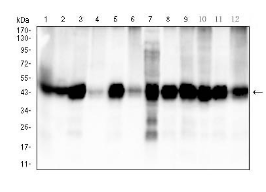
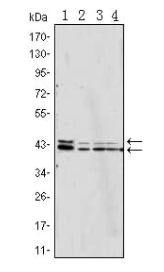
WB Predicted band size: 42 , 44kDa
Host/Isotype : Mouse IgG2b
Species Reactivity: Human,Mouse,Rabbit
Immunogen: Purified recombinant fragment of human MAPK expressed in E. Coli.


 WeChat
